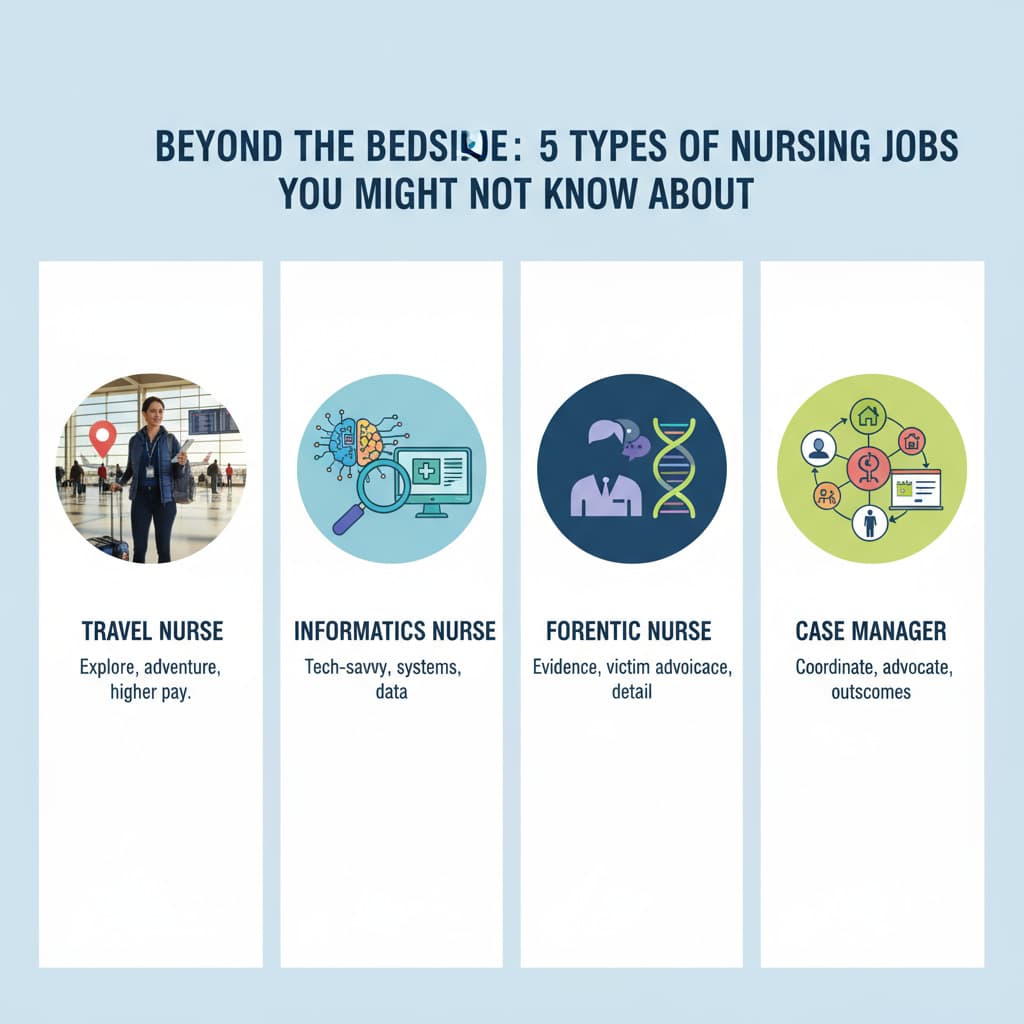
When most people think of a nurse, they picture someone working in a hospital room. While that’s the heart of the profession, the reality is that a nursing degree can open the door to a wide range of exciting and specialized careers. Expanding your search beyond the traditional hospital setting can lead to new opportunities and a better work-life balance.
Here are five types of nursing jobs that prove the profession is more diverse than you think:
Travel Nurse: If you have a sense of adventure, this could be for you. Travel nurses take temporary contracts (typically 13 weeks) at hospitals that have a staffing shortage. The pay is often higher, and it’s a great way to explore different parts of the country.
Informatics Nurse: This is for the tech-savvy nurse. An informatics nurse uses their clinical knowledge to help design and implement healthcare technology, like electronic health record (EHR) systems. You’ll be the bridge between the clinical team and the IT department.
Forensic Nurse: A forensic nurse provides care for victims of violence and abuse and collects evidence for law enforcement. This requires both a strong clinical background and a meticulous attention to detail.
Case Manager: As a case manager, you’ll coordinate a patient’s long-term care, helping them navigate complex health systems and connecting them with community resources. It’s a highly collaborative role focused on improving patient outcomes outside of the hospital.
School Nurse: If you’re passionate about preventative care and education, working in a school setting can be incredibly rewarding. You’ll manage chronic conditions, respond to emergencies, and educate students and staff on health and wellness.
Exploring these different paths can help you find a role that aligns with your specific interests and career goals.
I switched from nights on tele to a clinical research nurse role; about 70% of my week is coordinating trial visits and informed consents, the rest is source docs and IRB submissions - no 12s, Mon - Fri. If you’re curious, ask to shadow your hospital’s research coordinator for a clinic morning to see if it fits.
I moved out of bedside for better work-life balance by asking my manager for 4 hours a week over one month to shadow the quality team, then used those notes to show how my Epic chart-auditing translated to their role. That little trial made the switch feel low-risk for them and got me an offer without burning PTO.
After serving as the unit “superuser” for our Epic upgrade, I moved into nursing informatics — think bedside skills with lots of tabs open — and now my weeks are workflow mapping, tip sheets, and go-live support. If you’re curious, ask to lead one tiny EHR change and turn the results into a one-page portfolio, then DM an informatics manager or a recruiter on LinkedIn; @orca4527’s shadow idea pairs well with that. Caveat: go-live weeks can mean odd hours, so if that’s a dealbreaker, occupational health is a steadier alternative.
“better work-life balance” — I found that in occupational health; the move that helped me was emailing two local factories’ HR to ask for a 2-hour shadow, then bringing a one-page debrief with ideas (fit-testing flow, near-miss tracking) to the interview. Heads-up: fall vaccine blitzes can mean early mornings; if that’s a no, utilization review with insurers is very 9–5.
I got into clinical research by knocking out CITI training (https://about.citiprogram.org/) over a weekend and emailing our oncology PI a short “I can screen charts 2 hours on Fridays” note — landed a per-diem that turned full-time. It’s great if you like protocols and data, but the face-to-face time drops; is that a tradeoff you’d take?
I moved into telehealth triage and it scratched the “keep patients safe without bedside chaos” itch; a short CE on phone triage and getting familiar with Schmitt-Thompson protocols were enough to land an insurer role. It can feel like speed chess on the phone, so if you want more face time, shadow a home health case manager first to compare.