You’ve landed the interview—congratulations! Now it’s time to prepare. While you should always be ready to answer the classic questions, modern nursing interviews often focus on your clinical judgment, problem-solving abilities, and fit within the team.
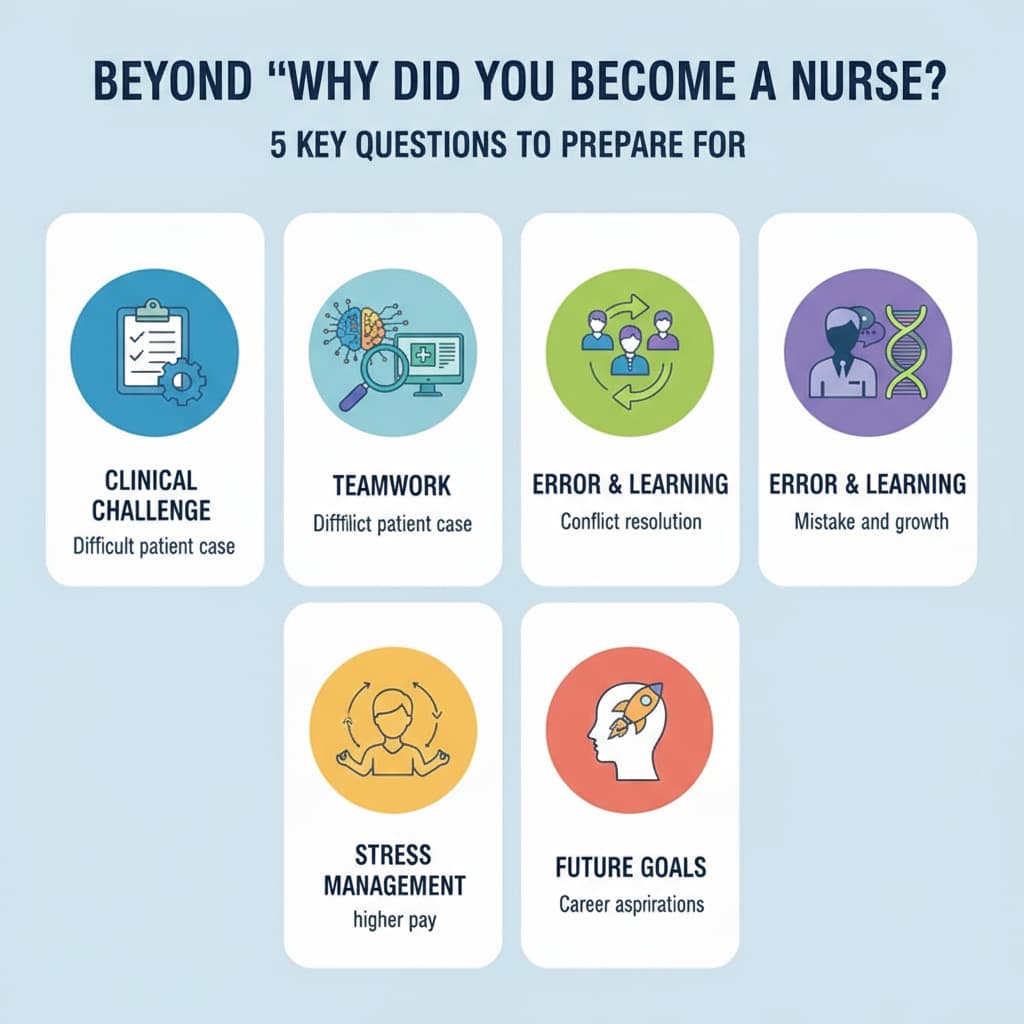
Here are five key questions to practice answering:
“Tell me about a time you had a difficult patient or family member. How did you handle the situation?”
What they’re looking for: Your communication skills, empathy, and ability to de-escalate conflict while remaining professional. Use the STAR method (Situation, Task, Action, Result) to structure your answer.
“Describe a time you had to make a critical decision with limited information.”
What they’re looking for: Your clinical judgment and critical thinking skills. They want to see how you prioritize, act under pressure, and ensure patient safety.
“How do you handle stress and manage multiple priorities on a busy day?”
What they’re looking for: Your time management skills and stress-coping mechanisms. A good answer shows you can stay organized and maintain a positive attitude.
“What do you know about our hospital/clinic/unit?”
What they’re looking for: Your level of interest and research. Before the interview, research the organization’s mission, values, recent awards, or a specific program they are proud of.
“Tell me about a mistake you made. What did you learn?”
What they’re looking for: Humility, self-awareness, and accountability. Everyone makes mistakes. They want to see that you can admit a mistake, learn from it, and improve your practice.
Go into your interview prepared, confident, and ready to show them that you’re not just a good nurse on paper, but a great one in person.
For that “difficult family member” question, I keep a 60‑second SBAR story ready: ICU night shift, son filming staff, I stepped into the hall, acknowledged fear, set 15‑minute update intervals, and moved updates to the whiteboard - behavior stopped and mom consented to labs. Interviewers like the structure and the concrete outcome.
I prep one 90‑second STAR story for each theme — kinda like a tight handoff. For “difficult patient,” mine is a delirious post‑op ripping at tubes: I screened CAM‑ICU, paged the NP to lighten opioids, removed mitts, brought in a sitter and 15‑min rounding, and alarms/near‑pulls went to zero that shift. I close with the takeaway (screen early, loop in the team fast) to show judgment and fit.
 .
.